These are for a class I’m taking. Bringing these into WordPress from Libreoffice was a cut’n’paste operation except for the images. These didn’t transfer and had to be added manually.
The Economist
Jan 18-24, 2020
Cover
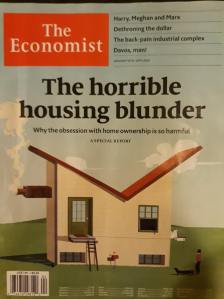
The cover depicts a simple but scrambled house – the roof is upside-down, the chimney’s out the side, the front door is not on the ground. That points to the issue’s main “Briefing” section, which discusses home ownership and whether it is a good policy goal for governments. The cover is concise and clever without being flashy. It suggests a target audience that is culturally conservative, educated and interested in economics. The lesser lead article references at the upper right hand corner further lure the potential buyer into getting the magazine or at least taking a peek at the articles.
Note the magazine price list at the bottom margin: sixteen different currencies! This suggests a well-traveled target audience – an appeal to vanity!
Table of Contents
The main item, “Briefing” comprises several short articles about home ownership and related policies and politics. The section “Leaders”, towards the beginning, has short summaries of the five lead articles including the “Briefing” item. There is a Letters section. The bulk of the magazine is collections of short articles grouped by region – Asia, Africa, Europe and so on. Toward the back, there’s a section containing relatively technical economic articles. There are book reviews. Finally, there is an obituary page for someone of note who recently passed away.
The majority of these articles are informational. They discuss news topics, but often provide more history and context than do daily newspapers.
Editor/Publisher Page
There is usually no editor/publisher article in The Economist, and this edition is no exception.
Articles
The articles have similar style, content and length. There are insets which are shorter than the articles but are of similar style. The titles are breezy, sometimes even with puns. The introductions are often anecdotal. For example, the lead article on back pain opens with the story of a specific person suffering from it. The body contains the details and the end often summarizes the point of the article (with occasional, subtle sharing of editorial opinion). Articles are almost always in third person, and often contain sidebars and graphs. There are no author attributions, nor are staff bios listed anywhere. There are text boxes declaring openings for staff writers. All this suggests that this magazine hires writers as staff and doesn’t use freelancers.
Advertisements
Perhaps 20% of the magazine is advertising. Ads are not interspersed with articles (as on airline magazines) but have their own pages, mostly at the beginning and end. Sometimes there are multipage advertising sections. In this issue, there’s advertising for Hong Kong. This issue has ads for business consultants, Lexus cars, and job advertisements. These are for various academics, a UN secretary-general and a couple of World Bank vice president slots. All this suggests a well-heeled, well-educated and well-traveled readership, working in finance and related fields.
The Big Question – want to write for them?
Possibly. The quality of writing is high as is the level of detail. I might be more able to write software for them, than to write articles for them.
Consumer Reports
October 2019
Cover

Consumer Reports started as a product testing organization but has expanded its role into more general topics. One of these is digital privacy and this issue discusses it at length. The big eye draws attention to surveillance as well as to the magazine on the shelf. The rest of the articles are product tests – one of which is named at the top (meatless burgers). Three other lead articles’ subjects at given at the bottom. There’s a “Reviews and Ratings” section with more items evaluated in this issue.
The lead article here (and typically) is an informational piece, usually with advice related to the topic. For example, the section on privacy contains advice for cell phone and computer users as well as topic information. Informational and advice pieces predominate.
Table of Contents
There is one page with featured articles (and tested/rated products as a sidebar) and a second page with regular departments and columns. The topics comprise a description of current tested products, general advice from their experts, reader feedback, a list of recalls and an index into issues by product. A number of departments relate to automobile tests and reviews – a Consumer Reports staple.
Articles tend to be informational. There are occasional profiles and news items.
Editor/Publisher Page
There is a “From the President” column. This personal note recaps (and explains the motivation for) the main article – digital privacy. It also plugs Consumer Reports’ other efforts in this area – product testing, activism, government lobbying and journalism. Her style is to the point and is serious. The article frames CR as an organization that does lots more than just test products.
Articles
A number articles are informational. There’s a section about digital privacy and an article about the virtues of used cars. Others offer advice; “CRInsights” contains picture-laden advice about driving position, tankless water heaters, and snack bars. A few of the articles describe test results and provide product ratings and reviews. This type of article is in the minority – most of these ratings and reviews are available by demand online.
Leads vary by article type. Often they summarize the article. They are always in third person, except fot the president’s page which is in first person. There are many sidebars and graphics…often these are for aesthetics rather than to convey information.
Authors are listed at the article head, and the magazine information block in the front contains long lists of staff writers, suggesting that the magazine doesn’t use freelancers. There are also long list of product test staff, some of whom might write for the magazine.
Advertisements
There are no ads in the magazine. This reinforces their independent stance. Readers seek objective advice about products (such as automobiles) and that suggests caution and a certain resistance to appeals to the emotions when buying things.
The Big Question – want to write for them?
Absolutely. I admire the organization. As an engineer, I might be able to work with them as a test technician, and write for them as a bonus. This would likely require a move to upstate New Jersey. Hmm.
Inside Sacramento
January 2020
Cover
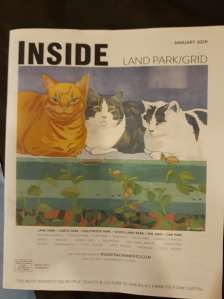
The cover has the distinctive INSIDE followed by the paper’s neighborhood edition – here, Land Park and downtown/midtown (the “grid”). The date is prominent at the upper right. The neighborhoods served by this edition are at the bottom, in bold font – other editions’ neighborhoods are not bold. There is nothing to indicate what’s inside INSIDE. An attractive picture makes the magazine visible and identifies the issue as old or current among regular readers.
Table of Contents
There’s no table of contents. I would guess this is a strategy to make readers scan more ads while thumbing through the paper.
Editor/Publisher Page
The publisher/owner, Cecily Hastings, writes the first article every month. Her topic varies. The article is first person and contains thought and opinion, often with a plug for her publication. Her style is personal and usually serious. This freedom as to topic, and the personal tone, are found in all the articles in the paper. It seems that the regular writers are given freedom to write as they wish.
Articles
Articles are similar in length. Most are by a regular-but-changing roster of freelance writers. Each writes one or more articles about their assigned area. For example, there’s a collection of local news snippets. There’s local issue coverage by various authors, many of whom are journalists (I recognize their names from the Sacramento Bee). There’s a design article covering some local house. There’s a spirituality article, and an article on transportation alternatives. Articles vary widely in style and person, and in their structure. There are few sidebars and graphics are rare. All have bylines, and the authors are freelancers. No writing staff is listed in the information block.
Advertisements
Perhaps 50-70% of the newspaper is ads. Ads are interspersed with articles and small ads occur all over the paper as insets. Most are for local businesses. Large spreads are given to real estate agencies for the target neighborhood. The typical reader is a resident of the target neighborhood and affluence and interests might be expected to vary by neighborhood. Land Park is affluent, and the ads range from private schools to coffee houses in the area. Notably, pot dispensaries and massage parlors do not advertise here. These businesses dominate the advertising for some other local newspapers (SN&R). Perhaps that suggests an older, more conservative clientele for this paper.
The Big Question – want to write for them?
I would certainly write for them. I know several people who have written for INSIDE. One was a capable local journalist and her themes varied. Another wrote about science. I think the writing standard is high and there is probably a minimum of editorial review, so that writers would have to produce good material without much need for vetting.
Ideas to query:
- A local news article covering my neighborhood.
- A local history article – we have many longtime residents and they have interesting stories to tell.
- Science?
- IT or computer support? That might lead to writing opportunities.


Leave a comment